Friday, August 17, 2012

Macedonia: Protests Against Price Hike in Skopje and Bitola

This article is also available in Macedonian
- на македонски на Блогспот: Протести против поскапувањата во Скопје и Битола
- на македонски на Блогерај: Протести против поскапувањата во Скопје и Битола 

All links lead to Macedonian-language content, unless noted otherwise.

On August 14, 2012, citizens of Skopje and Bitola held simultaneous protests demanding revoking of the decisions of the Energy Regulatory Commission of Macedonia resulting in higher prices of electricity, fuel and central heating for the citizens of Macedonia. The motto of this multi-ethnic protest was the exclamation Aman! (a plea originated in Turkish, and with the meaning "Please, don't!") and each gathered an estimated number (1, 2) of about 2.000 people. The participants considered this a serious crowd for a first protest, organized solely via Facebook event and Twitter (#АМАН, and previously #струја - electric current), without support of other offline structures and during the summer holidays, when these cities are somewhat deserted due to vacations.


Аман! Протест во Скопје - транспаренти, камери
Participant speaking at the beginning of the Aman! protest in Skopje. Behind him are sings with quotes by Kočo Racin, then in Turkish "Turn off the TV/turn on your brain/turn off the sound/raise your voice!" and in Macedonian "Be careful your parents might catch you tweeting during expensive electricity rate!"
Among the controversial decisions by the "independent" commission, whose members have been appointed by the omnipotent majority in the Parliament, are the abrogation of of the period of cheaper rate for electricity during the workdays  and introduction of obligations for paying fees to the central heating company in Skopje (Toplifikacija) per square meter even by people who have not made a contract with them. One of the motives for the price hike might be the fact that it would result in increased income from VAT for the state budget which is constantly depleted by overpriced buildings, facades and monuments, and for salaries of the overcrowded state administration, which has 164 thousand employees for 2 million inhabitants.

(Note: A reader who wished to remain anonymous sent me a link to the Parliament's site showing that the current president of the Commission, named as apparatchik of the ruling party by Utrinski vesnik, was appointed at the 60th session of the Assembly, June 15, 2009, without any argument, with 56 votes for and 0 against or abstained. I tried to find out if there were opposition members among those who voted, but the  PDF with the results is ineligible - it seems there is some conversion mistake.)   

Аман! Протест во Скопје - луѓе чекорат по бул. Климент Охридски
Aman! - Protest in Skopje, the head of the procession on Kliment Ohridski boulevard with signs in Macedonian and Albanian language
On the eve of the protest, the blogger Kiril Efremovski wrote:
Most of us know that price of electricity is a major input in every economy. This increase also results in a range of increases (in September). We will all feel it, and the people with lower income will suffer most. In addition, from today we also pay for more expensive fuel (gasoline price increased almost 15% during the last month [- continuous trend - in English]) which will also lead increase of prices of other products. Will you remain indifferent to all this? 
The same day, media reported that the price of bread will rise too, and that the state has taken new foreing loans.

The authorities did not respond to the citizens' demands. They combine official ignoring with a tactics of timing unpopular price hikes during holidays, and a propaganda offensive for distraction of the public through the lustration, as well as letting their mouthpieces confuse the public with comparisons with other countries.

The organizers announced that the protests will continue next Tuesday.

More photos from the Skopje photos and links to other sources follow.


Аман! Протест во Скопје - подготовки од птичја перспектива
Before the protest: People gathering at the feet of the Triumphal Arch and the building of electricity distribution company EVN

Аман! Протест во Скопје - транспаренти, ГТЦ
Sings: in Albanian "Turn of the TV, turn on your brain..." and "It's enough! Aman!", and also in Macedonian, plus "Who regulates the regulators," "The money is no problem/There's no money!," "The electricity begs you/don't turn me on/it will hurt you!" - pun on popular rhime.

Аман! Протест во Скопје - плоштад
A vies from beneath the Triumphal Arch Porta Macedonia

Аман! Протест во Скопје
Moving towards nearby entrance of the building housing the Energy Regulation Commission.

Аман! Протест во Скопје
Knocking on the Regulator's doors.

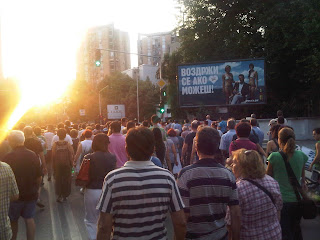
Аман! Протест во Скопје - реклама
Procession passing by a billboard with beer commercial stating: "Restrain yourself, if you can!"
Аман! Протест во Скопје - улица
People walking alongside Dimitrije Chupovski boulevard

Аман! Протест во Скопје
Moving on  Kliment Ohridski boulevard toward the Government building.

Аман! Протест во Скопје - леток
Protest leaflet glued to a window of a run-down pharmacy. The stickers behind inform that the place is for rent and that the pharmacy previously cooperated with the state Health Fund.


Аман! Протест во Скопје - Илинденска б.б.
Crossroads near the seat of the Government. Part of the people walk over Ilinden boulevard...

Аман! Протест во Скопје
...while the rest come through Kliment Ohridski boul.
Аман! Протест во Скопје - Влада
Passing in front of the Government. The modernist facade will soon be replaced with baroque.
Links:

Thursday, August 09, 2012

Germany: What is the Free Market Price of a Bronze Sculpture?

This article is also available in Macedonian and Albanian
- на македонски на Блогерај: Германија: Колку чини една бронзена скулптура на слободниот пазар?
- на македонски на Блогспот: Германија: Колку чини една бронзена скулптура на слободниот пазар?  
- në gjuhën shqipe në portalb.mk: Në Maqedoni luanët më të shtrenjtë se kudo  


I find it interesting to compare the price of bronze statues in an affluent market economy, with those bought under conditions of political party control of state resources, through public procurement.

This Spring in Berlin I came across a shop selling various art and decorative works. Several bronze life-size or smaller sculptures representing animals were displayed on the street in front of it. I assume they are intended to adorn the homes or yards of richer people who like to represent themselves as lovers of nature and the arts.


Bronze statues of animals displayed in the street in front
of a art shop in Berlin, Germany in May 2012.

The sculpture of a bear, with a size approximately 80 x 130 x 150 cm, costs EUR 5.800.

A paw of a bear statue with the price.

Thematically, the bear can be compared to the bronze lions from the Skopje 2014 project. Their artistic quality is similar or lower, and their size is about double. Meaning, they would need 4 times more bronze, because the volume in 3 dimensions needs to be filled.

Allegedly, the four lions on the "Goce Delchev" Bridge cost the state budget at minimum EUR 2.3 million. This price includes the pedestals, which feature quasihistorical reliefs like the one representing Aristotle teaching the future absolutist ruler Alexander that "democracy is the basis of freedom," a motto in Macedonian language inscribed with some strange mix of Cyrillic, Latin and Greek alphabet. It turns out that one lion + pedestal costs about EUR 570,000. Even if the cost share for the lion is... whatever... a fifth of the total price, it still boils down to over EUR 100.000 per animal sculpture.

I don't know if this is comparable - correct me if I am wrong, but to smelt a copy of the same bear with double size would cost 4 times more (~EUR 25.000) - taking into consideration the proportional amount of material. In essence, changing the dimensions of the work does not affect the author's fee, which was included within the initial price, and would be smaller or equal to it minus the price of the bronze and smelting. Even if making a bigger bear costs 10 times more, considering the need for additional skill or equipment, it still amounts to EUR 60.000. The large gap between this and the price of the lions could indicate the difference between a free market and an economy based on combination of communist-style economy concerted by the state and feudalism.

Thursday, May 31, 2012

Falkvinge on swarms vs traditional hierarchies. A re:publica video

This article is also available in Macedonian
- на македонски на Блогерај: Фалквинге за роевите наспроти традиционални хиерархии. Видео од ре:публика
- на македонски на Блогспот: Фалквинге за роевите наспроти традиционални хиерархии. Видео од ре:публика 

Good news! The organizers of re:publica conference (#rp12) posted the videos from the recorded sessions online a few days ago. Some of them are real jems, and I plan to recommend and reference them in appropriate context.

For starters, here's the presentation by Rick Falkvinge, the founder of the Swedish Pirate Party who talked about their experience in creating an activist movement based on "swarm" structure. Some of his lessons go against the logic used by traditional hierarchical organization, like the classical political parties.


For instance, Falkvinge mentioned the "three Pirate rule" - if three individual Pirates can agree to do something, they do not need any permission from the party leadership. In fact, the party leaders at every level serve more as community organizers or "janitors", taking care of logistics, while it's up to the members to figure out what to do - based on what they can do if it's within the limits of responsibility set in advance. "People won't joint the swarm if they don't know what it's for!" A swarm needs to have a purpose which is not up to discussion, a set axiomatic limits of why it exists in the first place. Therefore, it avoids the growing pains of other movements which have to put up with new ideas by new members on what everybody else should do.

Rick Fakvinge speaking about fun at re:publica 2012 in Berlin
Rick Falkvinge explains the importance of having fun to community
building at re:publica conference in Berlin, May 4, 2012. Photo: Filip Stojanovski

For internal and external communication (press releases! - traditional media are still important), the Pirate Party developed a software which they plan to release as open source. I asked Falkvinge whether such software, which basically can track members behavior and a lot more, has an added value of helping organizations that use it become more democratic, or it can be abused in this sense by non-democratic organizations. He said that the software helps flattening the organizational hierarchy, which removes the distance between the elected leaders, the activists &/ the voters, creating a tremendous "democratizing effect," creating universal trust. One could use the management features of this system "to support a dictatorship" too, but "it's not built for that. It's built to let everybody have a voice, and dictatorships don't usually like that, so it's not going to help them much..."


Tuesday, May 01, 2012

Serbia, Azerbaijan: Eurovision and Other Connections

Serbian writer Vladimir Arsenijević discussed the connections between Serbia and Azerbaijan, starting with the case of erecting a monument to late Azeri president Heydar Aliyev in Belgrade, covered by Global Voices.

His text, originally titled "Godzila vs King Kong" was first published in German by TAZ.de under the title "Galaxie der Eurokitch", also appeared on several independent portals in Serbian (e-Novine, Buka, Peščanik) and Macedonian (Okno). Arsenijević writes:
...Even though these countries are somewhat remote and have very different cultural, political, and economic concepts, they are also connected by a range of similarities. One of them--to tell the truth--is in the state of perpetual economic disaster, while the other is getting richer every day. One of them is ruled by an unscrupulous and insatiable political class, while the other is ridden by a classic rising dynasty and the accompanying nouveau riche clique. The differences are numerous, but the similarities are equally telling. Both countries are in a gripping search for a new and modern identity--each in its own way--unready or even incapable to denounce their old habits, the imaginative ways to abuse power, and their own historical and territorial obsessions and illusions. Neither of them enjoys some reputation within the international community. They are famous for pervasive, deeply rooted and incredibly durable corruption which in many ways infiltrates all pores of society. They are also famous for solving territorial problems by "defending" disputed areas (Nagorno-Karabakh, Kosovo) through bloody wars, which are lost together with the above mentioned territories. Both countries have difficulties with the basic understanding and respect for human rights and contemporary values in general, and their efficient implementation.
And, last but not the least, both Serbia and Azerbaijan,  have won the famous Eurosong, the Eurovision Song Contest.
And while mentioning that the Serbian hosting of the Eurosong 2008 brought a temporary respite of the endemic homophobia, which welcomed/ignored the gay tourists which flocked to Belgrade, Arsenijević draws various other parallels, and states:
...one could say that the Eurosong, in the sense of respect of the rules of good taste reflects the state of Azerbaijan and Serbia in the sense of respect for human rights and individual freedoms. This mega-pleiad of Euro-kitsch and Euro-amateurism promotes a conservative, endlessly conventional and foolish musical and any other kind of taste, spirit.. And even worldview, if you will, with the obligatory waving of state flags and voting according to national-ethnic relatedness. Therefore this is essentially an anti-European manifestation, a parade of bad lip-synched music and stupid songs turned into a hysterical contest which incites the lowest passions of the European peoples. 

Monday, March 26, 2012

Mali Tuareg Rebelion and Islands in the Net by Bruce Sterling

Bruce Sterlings's "Islands in the Net" (1988) remains a science-fiction book worth re-reading due to its resistance to time . Published over a quarter of century ago, it remains extremely current, in its anticipation of the influence of the Internet on the global scale. Part of the action takes place in Mali and is about the guerrilla fight of the Tuaregs/Kel Tamasheq, which recently gained prominence worldwide.


Tuareg fighter and Mali soldier.

Some time ago I noticed new Mali Tuareg-related article on Global Voices, which expanded into a continuous story after the military coup which attracted the attention of mainstream media. I decided to translate into Macedonian one of the articles, but ended up translating the sequel too, and supplemented that by translating part of the Wikipedia article on these people (as I presume most people at first glance would assume that Tuareg is just a vehicle brand).

Here are links to the original articles and their Macedonian counterparts.

Tuesday, March 20, 2012

Macedonia: A Blogger Reviews “In the Land of Blood and Honey”

Vnukot joined the debate about Angelina Jolie's movie by emphasizing the technical imperfections, and was especially unnerved [mk] that
“all the characters in the film speak languages related to Bosnia, the Serbo-Croatian as it was known then, or todays Serbian, Croatian and Bosnian language. However in Angie's ‘masterpiece' all of them, from a general… to the victims that have only one line before they get a bullet in the head, literally everybody, speak like Russian mobsters in some cheap American movie filmed in a cellar for USD 5,000. If this concept is remote to you, imagine a broken English interview of a Macedonian miss/mister universe/world candidate in China [1, 2, 3] - this film is worse!”

Monday, March 05, 2012

Macedonia: ‘Be a News Blogger’ Awards Announced

On Feb 29, 2012 in Skopje, Diversity Media Production, a non-profit organization which aims to advance journalism, freedom of speech and democracy in Macedonia, announced [en, mk, sq] the winners of their competition for young news bloggers:
  1. Novica Nakov
  2. Fatlume Dervishi, and 
  3. the authors of MK Demokratija blog - Monika Petrovska & Maja Peroska.
I served on the jury alongside notable professional journalists and the Diversity crew. It was interesting to read the various entries, and I hope the winners will continue writing. The first place winner is a seasoned blogger and well known member of the free and open source software community, while the others are recent arrivals to the blogging scene, and also students of journalism.

2nd place winner Fatlume Dervishi receiving a certificate from Filip Stojanovski on behalf of the jury,
with Vesna Kolovska and Nazim Rashidi of Diversity media,
and jury member Zoran Stevanovski on Skype from London in the background.

Thursday, March 01, 2012

Free Resource: Animated Hitler Meme

As a reaction to the corporate efforts to enact even more draconian legislation, and the attempts by distributor of the film Downfall to take down the Hitler meme on copyright grounds, Ribaro published [mk] an animated parody of the iconic scene, free for download and reuse under Creative Commons Attribution-Non Commercial License.

Friday, February 24, 2012

Announcing ENGAGE Conference in Skopje, Macedonia, Feb 25, 2012


The ENGAGE Conference on social media and activism will take place in Skopje, Macedonia on February 25, 2012, Saturday, at noon CET.

I am going to present Global Voices and Global Voices in Macedonian [mk] as representative of Metamorphosis Foundation. The conference is organized by Youth Educational Forum and their Internet radio, Radio MOF.

Thursday, February 23, 2012

Why there are no children's comics in Macedonia?

Lack of kids' comics publishing is a strong economic indicator related to absence of literate population with interest in development of their children.


Disney publications from Serbia, Croatia and Bulgaria (Jan-Feb 2012).