Wednesday, March 24, 2010

Marry Anning, a female scientist from the steampunk era

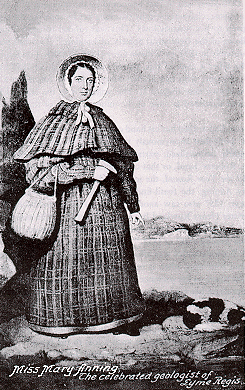
As part of the celebration of women in science and technology through the Ada Lovelace Day (#ALD10), I present Mary Anning (1799-1847) an autodidact paleontologist from Lyme Regis, England. She is noteworthy as a fossil hunter, who identified and dug out fossilized animals from the Jurassic period from Dover limestone cliffs for a living.

Fossil hunting requires both keen pattern recognition abilities, to differentiate bones turned into stone from ordinary rocks, and high hand-eye coordination, required while extracting the fossils from the sediments without damaging them. Anning family made a modest living by finding fossils and selling them to collectors as geology and nascent discipline of evolution started converging at the beginning of the XIX century.

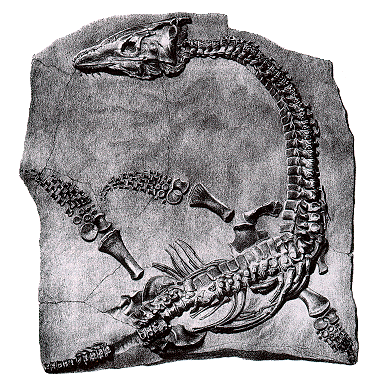
Some of the most interesting finds related to the Annings included marine dinosaurs: Ichthyosaurs and Plesiosaurs. Sadly...
...the majority of Mary's finds ended up in museums and personal collections without credit being given to her as the discoverer of the fossils. As time passed, Mary Anning and her family were forgotten by the scientific community and most historians, due to the lack of appropriate documentation of her special skills. Contributing to the oversight of Mary Anning and her contribution to paleontology was her social status and her gender. Many scientists of the day could not believe that a young woman from such a deprived background could posses the knowledge and skills that she seemed to display.
Sounds true. For instance, even though her story and finds are quite interesting the otherwise excellent Dinosaurs (Pockets) (1995) managed to omit Ms Anning entirely, even though it dedicated several pages to fossil hunters.

Plesiosaur: can you dig it?


I first found out about Ms Anning from Bil Bryson's excellent tome on the history of science A Short History of Nearly Everything. In addition, there are several biographies available about this remarkable person on the book market.

Tuesday, February 09, 2010

Join Ada Lovelace Day 2010

Ada Lovelace Day is an international day of blogging to celebrate the achievements of women in technology and science. On March 24th the participants post about cool women.

I participated last year [MKD] and received an e-mail reminder to join this year too. I plan to cover another geek girl this time, but in preparation, here's what I wrote then:
Ада ЛавлејсAugusta Ada King, Countess of Lovelace (1815-1852) is the world's first programmer, who worked with Charles Babbage--the creator of the Analytical Engine, the first modern computer--during the steampunk era.

She was also a daughter of Lord Byron and invested her soul and body in the aristocratic-intellectual world of "sex & drugs & rock & roll" of her time, which then had the form of "sex & drugs & romanticism."

In order to support this international awareness raising action about the important role of women in the technological progress, sign the pledge ;-) [last year's version, closed now - the smiley is due to particular choice of translated word, which has pompous, even religious overtones in Macedonian] and publish a post about one of your techno-heroines.

This is very important for the women of the world, especially little girls, who are overwhelmed with non-proportional presence of male authority figures in all areas of social life. In Macedonia this pressure is omnipresent, from primary schools (just look at the proportion of male and female faces in the textbooks, for instance on literature) to politics [MKD].

Saturday, January 09, 2010

Prediction: Josipović to Win Croatian Presidential Elections

This post is also avaliable in:
македонски (Блогерај): Предвидување: Јосиповиќ ќе победи на изборите во Хрватска

македонски (Блогспот): Предвидување: Јосиповиќ ќе победи на изборите во Хрватска

If I would need to bet on the outcome of tomorrow’s Croatian Presidential Election, I would put my money on Ivo Josipović, who I think will crush opponent Milan Bandić.

I do not base this prediction on the outcome of the first round of the elections, or the polls. News about these favor Josipović, even though A1 TV speculates [MKD] that there could be a reverse if right-wingers, and the Diaspora rally around Bandić. I base the prediction on the method I tested through the research done by Metamorphosis Foundation about the use of new media during the Macedonian Presidential elections in 2009 (PDF) [MKD].

This research showed that by measuring the support on Facebook before the election, one could accurately predict the outcome, which in case of Macedonia also meant predicting the percentages of actual votes with an error of around 1%. The method involves identifying and comparing the forms of support (profiles, pages or groups) with maximum supporters.

In case of Croatia, I identified the official pages of Ivo Josipović [CRO]—with 22,729 fans—and Milan Bandić [CRO]—with 20,853 fans. The comparison yields the prediction that the former will triumph with around 52.15% votes, while the later will win no more than 47.85% of the valid ballots.

(The data is from 20:00 hrs on January 9, 2010. While the absolute number of supporters can change over time, I think that the critical mass is achieved and that any changes will cancel out each other and the percentages would remain similar.)

Okay, now let’s wait and see if we can use Facebook again as good prediction tool.

Saturday, November 07, 2009

Biodiversity on the coats of arms of Europe & surrounding areas

This post is also available in
Macedonian: Лавот наспроти орелот (на грбовите на Европа и околина)


As a contribution to the decades-long public debate on the coat of arms of Republic of Macedonia, I provide a graphic analysis of the animals used on the coats of arms and emblems of Europe and nearby areas. It's a kind of best practices study. Since the dispute in Macedonia focuses on two alternatives, with some ethnic Macedonians favoring the lion, and some ethnic Albanians favoring the eagle, the map pays special attention to these two symbols.

Click on the image for a larger and more detailed version of the map.

This is not a scientific study (yet), since the main source of data used is Wikipedia:
It would be interesting to do an overview of symbols used all over the world. For instance, no country uses an ostrich, but two have Kalashnikov assault rifles.
Note: on the map, the "no animals" category includes coats of arms featuring human figures (even though humans are animals, too).

Monday, August 31, 2009

Wednesday, May 27, 2009

What do Macedonian Facebook users do with the ads by Macedonian companies?

A survey of 450 Facebook users from Macedonia indicates that very few of them—one percent—actually use the benefits of e-commerce provided by this environment, and that over a third of them do not click on the advertisements by Macedonian firms served by this social networking platform. Even though majority claim to click on the advertisements, most of them do not do that often, and almost two thirds of them have visited the advertised websites only once.

Methods

To gather the data, I posted a note (simple text article) available to all Facebook users, containing the question and the alternative answers (closed set). Users were invited to provide the response via private messages or to post them as comments with the number of the alternatives, and additional info at their convenience. The decision to use a note, as opposed to a specialized poll or quiz application, was based on the aversion experienced as a user, and corroborated by other users, to the constant influx of invitations to install new applications.

This user-friendly approach and the nature of the social media contributed to increasing the number of participants, some of whom shared the link among their friends. The data gathering took place from May 20, 2009 till May 30, 2009.

All communication and inviting took place strictly in Macedonian language, in order to provide a sort of filter for foreign friends of the surveyor and the respondents who might notice their activity regarding the note.

The responses are based on respondents’ recall and can be used to gain a rough sketch of the current state of the affairs, but cannot be taken as precise measurement of the effectiveness of the Facebook ads, or the level of use of e-commerce in Macedonia. However, it must be taken into account that Facebook users as a group can be considered to be potentially more wired than the general population of Macedonia, for at least they need to know to use the web and e-mail to start using Facebook.

In addition, six respondents, who reside outside of Macedonia, also took part in the survey. Their responses—that they do not notice such ads—confirming that the ads by Macedonian firms are targeted according to geographical location of the viewers. The responses by the Diaspora members were not included in the final tally.

Results

Out of total of 456 survey respondents, 450 persons from Macedonia answered the question: “What do you do with the advertisements by Macedonian firms on Facebook?”. Cleared data from 435 respondents indicates that:
  • 27,4% do not notice those advertisements
  • 6,0% intentionally do not click on them
  • 37,0% click on those advertisements very rarely or never
  • 25,3% occasionally click on such advertisements, and
  • 4,4% often click on them
Several respondents who choose the first option also reported that they use Adblock Firefox Add-on, or other service which automatically prevents them from viewing ads. Future surveys on this topic should add this possibility as separate option.

In addition, the respondents were asked what they have done after clicking on such advertisements. The 294 survey participants, who first confirmed that they’ve clicked on such ads, responded as follows:
  • 67,7% - I have visited the advertised websites only once (then and never again).
  • 16,0% - I have returned to an advertised website several times.
  • 3,1% - I have placed an advertised website in the bookmarks/favorites.
  • 1,4% - I have bought a product or a service directly from such a site.
  • 0,3% - I have bought an advertised product or service via telephone.
  • 2,7% - I have bought an advertised product or service from a shop.
These results show a correlation with the results of a study of banner ads effectiveness published by the American company iProspect, in particular in regard to 36% of users who choose the option “Nothing. I haven’t responded to any such ads,” within this survey, which is quite close to over 33% of Macedonian users who selected one of the two options with the result of non-clicking on the ads.

However, over 66% of all respondents reported clicking on the ads by Macedonian companies, which points out that this targeted advertising on social networks indeed has a strong potential for reaching the intended audience. This notion needs to be confirmed by data on the actual Click-through rates (CTR), even though the CTR can take a back seat to building brand awareness by users who just see the ads and tend to get familiar with the advertised brand name.

The low level of actual online purchases done by the Facebook users can be due to the low level of development of e-commerce in Macedonia, which also indicates low user confidence in the existing domestic e-shops. Only one percent of the respondents who clicked on the ads confided that they’ve purchased an advertised product or a service online, as compared to three percent of them who later used a brick-and-mortar shop to conduct an actual business transaction.

Assumptions and Limitations

The main limitation regards the possible bias of the sample, which included 450 self-selected respondents, a number of whom are not surveyor’s Facebook friends, so even their self-reported data such as sex could not be accessed and verified. Estimated sex ratio for this group is 48% to 52% for males and females, respectively.

The assumption for this survey is that ratio of male to female users on Facebook reflects the estimate for the general population of Macedonia of 50% each. This could not have been verified, as Facebook estimates the ratio of males to females for users of all ages (by the rule: over 13) from Macedonia to roughly 51% to 49%. This estimate is prone to errors due to using self-reported sex info as basis, and taking into account that some users do not input this data. For instance, on May 26, 2009, the official estimate by Facebook for the total number of users from Macedonia was 170,360, with 84,660 males and 83,120 females, leaving 1240 unaccounted for. Even more peculiar is that the total number for males and females from Macedonia provided by Facebook is 168,800, while the simple sum of the above numbers is 169,120, with an unexplained difference of 320.

A rough estimate of the ethnic affiliation could be made, based on personal acquaintance and used surnames, yielding a ratio of 82% of ethnic Macedonians, 4% of ethnic Albanians, and 12% of people belonging to other ethnic communities (Serbs, Croats, Turks, Vlachs, Roma, Slovenes, etc.) or whose affiliation is undeterminable at this point. This does not provide a strong correlation with the general population. According to the 2002 census, the population of Macedonia consists of 64% ethnic Macedonians, 25% ethnic Albanians, and 11% others.

Facebook does not collect data on ethnicity or native language, and it cannot be verified if the above estimates point to a kind of digital divide between ethnic communities, indicating that a larger proportion of members belonging to one of these categories use the system.

Taking all the assumptions and limitations into account, no efforts were made in order to dig deeper into the data, such as cross-indexing of gender and a particular response. Even though the sample size of 0.26% of the total population of Facebook users from Macedonia is not negligible, to segment it even further would be too ambitious for a survey of this kind.
Wednesday, January 28, 2009

80 years of Tintin


Brussels celebrated the 80th birthday of the comics hero Tintin two weeks ago (Jan 14 2008) by unveiling a huge mural in the Luxemburg train station. The representative of the copyright holder mentioned that one of the important values promoted by the comics is the right of young people to travel.

The photo: “official” collectible figurines with the comics’ characters I photographed on Brussels airport in March. These are some of the "moderately" priced, over EUR 200 each. There are other similar collectibles which cost three times as much, and I’ll write some more about it soon.

Saturday, November 29, 2008

The First (!?) Macedonian webcomics: Vlado’s World

At last an independent Macedonian artist has started publishing a genuine webcomics [MKD].

The artist Vlado Janevski has posted several ironic-autobiographical strips on his blog, made in English:

Thursday, October 30, 2008

Paris: Street Protests against Education Budget Cuts

Last Sunday the protestors filled the streets of Paris, demonstrating against the decisions of the French Government to cut the education budget, while using public money to subsidize banks, using the financial crisis as an excuse.

Numerous leftist political parties, unions and groups took part in the protest. For me as a visitor it was interesting to whiteness the diverse demographics of the participants, both in regard to gender and age. I tried to document the various message spreading techniques by this small video made with a mobile phone:


Such tools included disseminating lyrics from protest songs and slogans on paper (leaflets), groups of drummers using professional drums or plastic cans, while using balloons as effective placards was a novelty to me. Concerning logistics, the march included vans selling sandwiches to the participants, and other logistics. The walk took many kilometers, through several main Paris boulevards.


In fact, the most effective noise-making tool available to individual persons seems to be the cowbell, like those on the photo. Their sound travels very far with high quality.


Friday, September 19, 2008

Macedonia: Fighting Corruption with Online Video

In order to aid the fight against corruption, and for increasing transparency and accountability of the government, the Macedonian blogs Komunikacii and Panta Rei published several video-clips used by citizens to document abuse of power in the municipality of Centar, а constituent part of the Macedonian capital Skopje.

The clips posted on YouTube contain fragments of conversations with the municipal officials and public servants who allegedly refrained from removal of illegal buildings under their jurisdiction. This online video aspect of the "Platina" case—named after the building company—was first revealed by the Nova Makedonija daily, and was also reported by the portal Taratur.