Serbia, Macedonia, Albania, Montenegro, BiH: UK Must Fulfill Conditions to Exit the EU
Skopje, January 24, 2013, (Njuz) – The Council of Ministers of the countries of the Un-European Union stated today in Skopje that a long road lies ahead of United Kingdom in order for it to join this international organisation.
Great Britain is impaitently awaiting the decision of the "Great Five"
By way of reminder, the United Kingdom of Great Britain expressed its intent to step out of the European Union (EU) yesterday. However in order to do that it shall have to fulfill a range of preconditions. "Great Britain will first have to sign a Stabilization and Association Pact, and then start a comprehensive process of harmonization of its legislature with the regulations of all countries that are not European Union members. Key priority areas are the regulations on freedom of the media, judiciary, human rights protection and corruption. Only afterwards we shall be able to talk about getting a candidate status, while it is too early to talk about the date for the start of negotiations," said Nikola Gruevski, Prime Minister of Macedonia, the country that currently chairs the Un-European Union.
According to unofficial allegations, significant discord exists among the "Great Five" about whether the time is right to enlarge this organization.
"Some members, like Serbia and Bosnia and Herzegovina for example, consider it too risky to accept a former European Union member-state as a member, due to concerns that the wave of unemployment and poverty could spill over from the EU to the Balkans. However, majority agrees that Great Britain deserves a chance, considering that this country was not a dedicated European Union member, anyway. Supporting this argument is the fact that Britain never abandoned its national currency, which would ease its entry to the Non-Euro Zone," stated a high official from Skopje, on condition of anonymity.
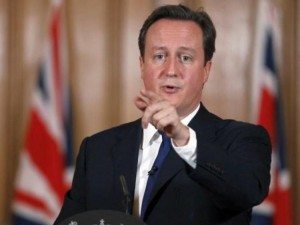
British Prime Minister David Cameron stated today that he feels encouraged by the positions of official Skopje, and that his country will do everything possible to fulfill the conditions as soon as possible.
Bojan Ljubenović
Saturday, January 26, 2013
Saturday, December 08, 2012
Peru: Inca Ritual of "Golden Shovel"
 I recommend the book Realm of the Incas by Victor W. von Hagen to all interested in understanding how the Incas--the last dynasty of ancient Perú--managed to create, manage, and lose their empire, which they called Tawantinsuyu - "The Four Quarters of the World."
 Von Hagen presents and interprets archeological and historical evidence in comparison with other ancient and modern cultures in a very accessible and unconceited manner. For instance, an excerpt from pages 64-66:
Agriculture was the soul of the Inca Empire; it determined everything. The Andean farmers' year was divided into two seasons: wet and dry. The wet season began in October and extended to May; the dry season, starting in May, although subject to considerable caprice (hence the Inca's preoccupation with obeisance to the unseen powers), continued into November.
In the autumn the lands of the commune were divided fairly between the members of the ayllu, the earth cell which controlled the communal land tenure. First the lands (chacras) assigned to the Inca, that is state lands, were cultivated communally (part of the Indians' mitta tax of service), then the lands of the sun, the state religion. The fruits thereof were harvested and stored for the use of these agencies. These state granaries were stocked, so the early Spaniard remembered, with maize, quinoa, chuñu, charqui (dried llama meat), fish, cords, hemp, wool, cotton, sandals, and military arms, stored in hampers, each item in its appropriate warehouse. They were seen by Francisco de Xerez, the first soldier-chronicler of the conquest of 1533, who remembered these storehouses as being "pilled to the roof, as the Merchants of Flanders and Medina make them."
The work of tilling these fields done, the puric then turned to his own.
August was plowing time, and work in each other's field was--like all else-communal. It began with a festival. The nobility took it all most seriously and always participated. "If," wrote the Jesuit historian Padre Cobo, "the Inca himself or his governor or some high official happened to be present, he started the work with a golden digging stick which they brought to the Inca, and following his example all the other officials and nobles who accompanied him did the same." (No different in idea today than some state official turning the soil with a gold-plated shovel or else laying a cornerstone with a golden trowel.*)
 |
| Men and women plowing the fields together. The men use the foot plow, called taclla; the women break up the clods of earth. Another woman brings corn chicha to drink. From "El Primer Nueva Corónica Y Buen Gobierno" by Felipe Guamán Poma de Ayala. |
They had no plow as such, and no draft animals. Men used, as they still do, the taclla, or foot plow, which was a thick pole six feet in length with a fire-hardened point; sometimes it was bronze-tipped. There was a footrest near the tip and it was driven deep into the soil by a thrust of the foot and shoulder pressure. The digging stick, like all else in the realm, was a group tool and was seldom used by only one man. His kinsmen of the ayllu formed a long line across the field to be plowed, and with a rhytmic chant "Jailli" (pronounced "whaylyi," which means "triumph"), "...they triumphed over the soil, writes Garcilaso "the Inca plowing it and disemboweling it."
Von Hagen asserts that the Inca dynasty based its absolutist power on superb organizational skills using and upgrading the great achievements of conquered cultures, creation of religious personality cult, and control of the culture by perpetuating a myth that they were the sole civilizing force. Their empire was low-tech totalitarian welfare state which fostered dogma, group-think and isolationism, as ultra-conservatives they could not cope with new concepts such as the notion that other civilizations may exist across the sea.
QHARICUNA:
Ayau jailli, ayau jailli
Kayqa thajilla, kayqa suka!
Kayqa maki; Kayqa jumpi!
WARMICUNA;
Ajailli, qhari, ajailli
Free translation
THE MEN:
Ho! Victory, ho! Victory,
Here digging stick, here the furrow!
Here the sweat, here the toil!
THE WOMEN (answering):
Huzzah, men, huzzah!
The men worked backward, the women followed facing them and breaking up the clods with a sort of hoe called lampa. Sara (corn) was planted in September, potatoes when the rains began to fall, i.e. between October and November. After plowing the fields of the Inca, the Sun, and their own, they next turned to those fields of kinsmen who were serving in the army, and then finally to those of the sick and the halt. Their principal tribute (it was part of their tax), said Garcilaso, was "the working and cultivating and harvesting of the lands of the Sun and the Inca."
* Modern example from Macedonia: Top religious authorities auctioning a golden shovel while consecrating a new building. While the state is nominal secular, the politicians and leaders of religious institutions often benefit from combining their areas of competence. All construction activity paid by the state is subject to rituals involving religious blessings and obligatory photo-op of politicians throwing the first shovel of dirt &/ cutting red ribbons.
Tuesday, December 04, 2012
No Memorial Service for the Victims of "Donkey Assasinations," Again
Once again, Macedonia has failed to commemorate one of the darkest days in the history of Štip: On December 4, 1911, as a consequence of the so-called "Donkey Assassinations," dozens of citizens lost their lives, and hundreds were wounded.
The goal of this terror campaign (which also included Kichevo and Dojran) was to incite inter-ethnic and inter-religious hatred resulting in physical violence - mutual slaughter of the population of Macedonia. The primary targets were Muslims, who would took revenge on the Christians, which supposed to create chaos that would invite intervention by the neighboring states, with an end result of complete division of Macedonia. Along the way, those who incited the strife would end up as feudal owners who would privatize and "independently" rule whatever piece of territory they can scoop up from Macedonia.
 |
| Štip by the end of XIX century. Photo: Wikipedia. |

The Wikipedia in Macedonian article on the "Donkey Assassinations" („Магарешки атентати“) references the book "Treason and Assassinations in the Macedonian History" („Предавствата и атентатите во македонската историја“, 2004) by the state historians Violeta Achkovska and Nikola Zhezhov. They point out that the primary motive for the assassinations involved racketeering. The operations involved members of the pro-Bulgarian, "Autonomist" IMRO disguised as peasants bringing time bombs on donkeys, and leaving them in markets or near religious objects. An excerpt from the article follows, while the quotes in brackets are from the book, which covers this topic from around page 143:
As a result of such terrorist activity on December 4, 1911 in Štip in less than an hour, 20 Christians were killed by angry Muslim mobs, and hundreds were wounded. Initial reports by the Kaymakam of Štip to the Wali [Ottoman governor] of Kosovo Villayet justified this act of violence with an alleged bomb planted near the mosque wall, which injured three Muslims, with one of them dying from the wounds.
[...]
Citizens of Štip suffered the most due to this event, regardless of their complete innocence regarding any participation or approval of the initial crime. In fact the assassination "was inspired by the desire to punish them, and to provoke an incident." British Consul noted that after the shocking "murder of six Muslims near Kiliseli, and the legal consequences and other processes in Štip, ...last year, the local elders decided to terminate any relations with the organization lead by Todor Aleksandrov, refusing to pay contributions to his funds--which they did until then--and to receive and smuggle his emissaries upon their visits to the city." After that, Aleksandrov announced his intention "to bring them to their senses."
Several months ago, several right-wing political parties including the ruling party running the Government of RM paid respects to the organizer of these assassinations, Todor Aleksandrov. They organized several Orthodox Christian memorial services in his honor, attended by at least one governmental minister. They even built an EUR 73.000 equestrian monument dedicated to him in Skopje (unnamed at the time of erection, then amended with an inscription of the name), and sang а song about him during party celebration. However, not a word about the victims. So when authorities in Macedonia talk about honoring tradition, remembrance of the hardships of the common people does not come into play. Citizens of Štip did not make a peep.
PS
Several years ago, Zarko Trajanoski asked the same question. Sadly, in recent times, 101 years after those loathsome events, similar modus operandi was used for several incidents to incite inter-ethnic and inter-religious hatred. History should be thought as a way to avoid repeating past disasters, not as a list of models to imitate...
Sunday, December 02, 2012
New Kind of "Russian" Spam on Twitter
This article is also available in Macedonian | Овој напис е достапен и на македонски
- на Блогерај: Нов вид „руски“ спамови на Твитер
- на Блогспот: Нов вид „руски“ спамови на Твитер
I came across a new kind of "Russian" spam - I use the term provisionally because the senders all have Russian names. What they do is make mentions of other twitter users and include text of older tweets sent to them. I assume this is a way to make the tweets look more "legit."
I document through photos, as I also reported them to Twitter for spam, which will hopefully lead to their removal.

The first round of such tweets also have retweets from their "pals."

The text was taken from a tweet by RubinBt, who responded to my question five days before prior (related to a Global Voices post).
Possibly the sender/s who controls those profiles is not proficient in Macedonian language at all...
- на Блогерај: Нов вид „руски“ спамови на Твитер
- на Блогспот: Нов вид „руски“ спамови на Твитер
I came across a new kind of "Russian" spam - I use the term provisionally because the senders all have Russian names. What they do is make mentions of other twitter users and include text of older tweets sent to them. I assume this is a way to make the tweets look more "legit."
I document through photos, as I also reported them to Twitter for spam, which will hopefully lead to their removal.

The first round of such tweets also have retweets from their "pals."

The text was taken from a tweet by RubinBt, who responded to my question five days before prior (related to a Global Voices post).
@razvigor Здраво боби беше успешен тролинг проект на твитер заедницата инспириран од поздравот на една селебрити кон својот најголем фан
— Брзи Рабин Рубин (@RubinBt) November 24, 2012
Possibly the sender/s who controls those profiles is not proficient in Macedonian language at all...
Thursday, November 15, 2012
Macedonia: Promotion of Loring M. Danforth's Book on Greek Civil War Refugees in Skopje

The Foundation Open Society Macedonia has published Macedonian translation of the book Children of the Greek Civil War: Refugees and the Politics of Memory by Loring M. Danforth and Riki Van Boeschoten; and is organizing a promotional public debate in Skopje on November 16, 2012. Both coauthors will attend.
The debate will take place this Friday in Holiday Inn hotel at 11:00 hrs CET, and if you are unable to attend in person, there will be live video streaming via the service vozivo.mk. This service also uploads the video recordings of such events (also on FB) it covers, with a delay of few days, so if you miss it all, you'll be able to make up.
Loring M. Danforth is a Bates College professor, and the author of classic anthropological work on ethnic Macedonian identity The Macedonian Conflict: Ethnic Nationalism in a Transnational World [Amazon.com]. Over the years, numerous sites have quoted excerpts from the book, including myself in 1995 on my personal website I built as a student at Institute of Informatics.
Vasiliki P. Neofotistos wrote the following in her review of Children of the Greek Civil War: Refugees and the Politics of Memory [Amazon.com]
Loring M. Danforth and Riki Van Boeschoten offer a masterful, original, and rich ethnographic analysis of the evacuation of children, self-identified as Greeks and Macedonians, from their homes in northern Greece by both parties in the Greek Civil War of 1946–1949, namely the royalist right-wing government and the Greek Communist Party. The refugee children—that is, children who were usually between the ages of three and 14, though often younger or older children as well, who were “forced to leave [their] home[s] and country of origin because of a well-founded fear of persecution” (265)—were evacuated to children’s homes operated by the Greek Communist Party in Eastern Europe and to paidopoleis (literally meaning “children’s cities”) by the Greek government in locations throughout Greece. Based on archival research and ten years of fieldwork in multiple locales around the world, the authors explore in three neatly organized and tightly knit parts the intersection between the stories of lived experiences as told by individual refugee children after the end of the Cold War and the history of the Greek Civil War. They provide pioneering insights into a still controversial episode in Greece’s modern history and maintain a remarkably balanced and sensitive approach, whereby a wide range of personal experiences and perspectives on the Civil War is presented and analyzed in a sophisticated manner. [...]Promoters of the Macedonian edition will include Todor Chepreganov, director of the Institute for National History, and Ljupcho Risteski, professor at the Institute for Ethnology and Anthropology in Skopje. FOSM executive director Vladimir Milcin will serve as moderator of the public debate.
Friday, November 09, 2012
Armenia: Trees Turned into Sculptures
This article is also available in Macedonian and Albanian
- на македонски на Блогерај: Ерменија: Дрвја претворени во скулптури
- на македонски на Блогспот: Ерменија: Дрвја претворени во скулптури
- në gjuhën shqipe në portalb.mk: Armeni: Drunjët shndërrohen në skulptura
Examples how trees can remain part of the urban environment after their natural death. I made these photographs on the streets of Etchmiadzin, Armenia, in October 2006.


I already wrote about this (in Macedonian, on Blogspot and Blogeraj) back in 2009, when Skopje City Government started the first massacre of trees on Ilinden boulevard.
The city of Etchmiadzin is a spiritual seat of the Armenian culture, holding the seat of their national church. The complex containing the main cathedral is open and organized as a park with much greenery.


- на македонски на Блогерај: Ерменија: Дрвја претворени во скулптури
- на македонски на Блогспот: Ерменија: Дрвја претворени во скулптури
- në gjuhën shqipe në portalb.mk: Armeni: Drunjët shndërrohen në skulptura
Examples how trees can remain part of the urban environment after their natural death. I made these photographs on the streets of Etchmiadzin, Armenia, in October 2006.
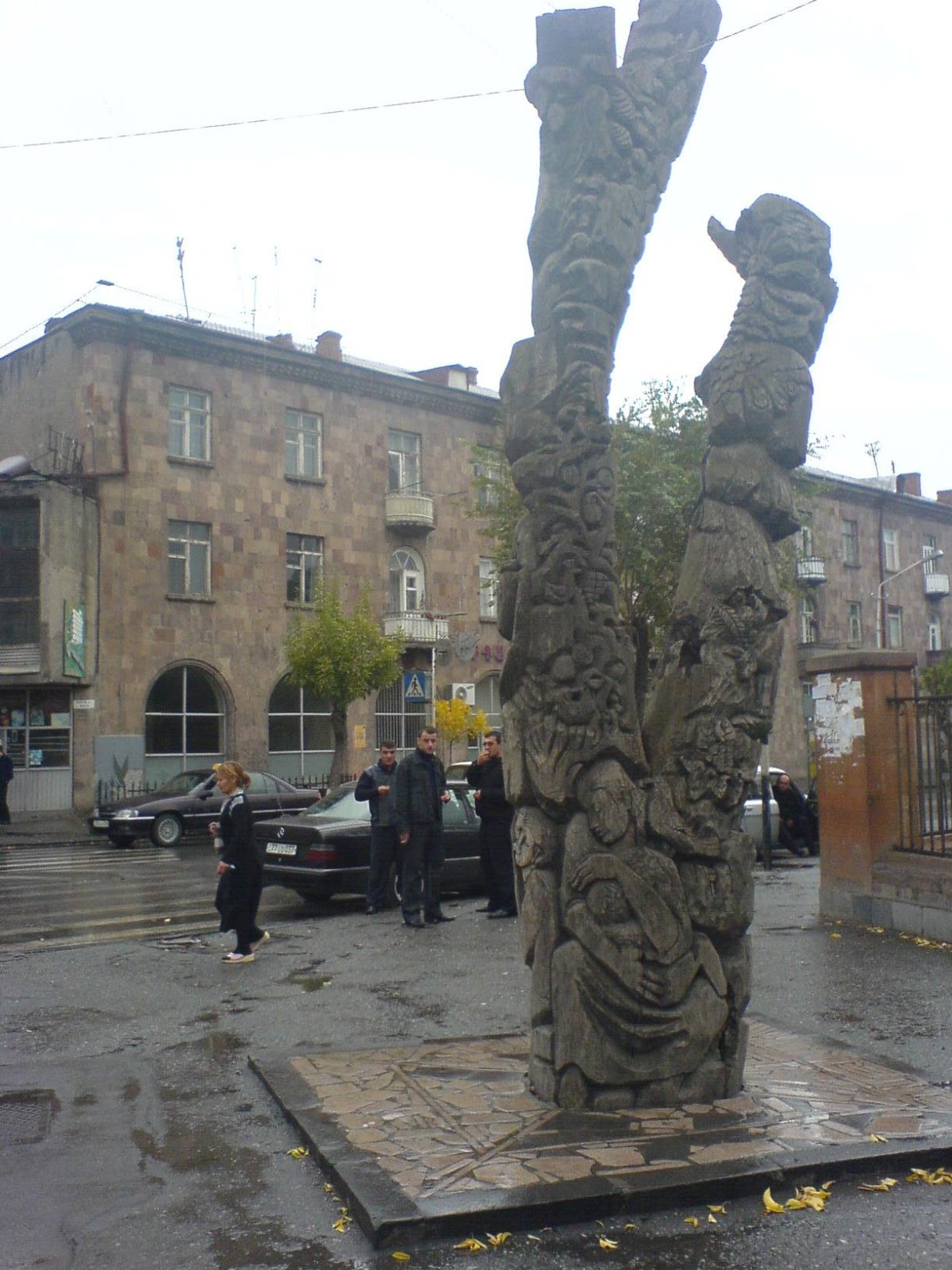


I already wrote about this (in Macedonian, on Blogspot and Blogeraj) back in 2009, when Skopje City Government started the first massacre of trees on Ilinden boulevard.
The city of Etchmiadzin is a spiritual seat of the Armenian culture, holding the seat of their national church. The complex containing the main cathedral is open and organized as a park with much greenery.


Wednesday, October 24, 2012
Macedonia: PM Questions "Some Kind of Rights" for Women; LGBT People Under Durres
 |
| "Hate Speech breeds Violence" Photo: The Palm Beach Post |
At the Commemorative Event of the public holiday Day of Macedonian Revolutionary Struggle (October 23, 2012), attended by the state leadership, including the President Ivanov (father of one child), the Prime Minister Gruevski (once divorced, fathered two children with his current second wife) held a speech [mk] which caused much turmoil among the citizens, especially those concerned with equal rights for men and women.
Incidentally, the official English translation of this speech seems to be cut short before the PM went into elaborating its main topic - the need to procreate more to boost the economy. The most representative paragraph which was quoted by local media states:
"Today, when we are in incomparably better condition than 60, 100 or more years ago, we, to tell the truth, alongside most of other European countries, face a crisis of family values, with serious long term and so far unstoppable trend of decline of fertility. We live at a time when it is increasingly rare to have a second child in the families, to speak of third or fourth. Contrary to that we lead debates about skewed values, about single-sex marriages, and even about adopting children in those single-sex marriages, about some kind of rights for women, and of men, about which one of them is more represented in politics or in business, and while we spend ourselves on those topics, as a state we are missing a people," Gruevski said.
The speech and especially the term "some kind of rights" caused uproar on social networks. Many shared [mk] the link to a speech on German womanhood by Joseph Goebbels from 1933 alongside the news [mk] to incite people to compare and contrast. The fact that the same-sex marriage "debate" designated as pointless the PM is initiated and "lead" by his own subordinates, members of his party which imposes iron discipline and top-down coordination on all PR matters was also not considered an example of irony.
During the same day, Macedonian Helsinki Committee opened a LGBT center in Skopje. During the night, the premises were attacked with much material damage.
On October 24, some women CSOs reacted [mk] to the PM's putting the blame on women for not giving birth to enough babies, thus creating problems of competitiveness, investments, expenditure, and roads... by stating that women are "not a group nor some kind of machines." Some female MPs asked the PM to explain the meaning of his speech at the session of the Parliamentary Committee for Equal Opportunities for Men and Women. Speaking in his defense, Ms Liljana Popovska, MP, whose party DOM is a member of ruling coalition said that:
In other news, the Minister for Labor and Social Policy (whose official CV omits his marital status, but dependable social media users claim he is and has two kids) again opined [mk] on the issue of low birthrate, providing a nice example of Freudian slip (italic):During the same day, Macedonian Helsinki Committee opened a LGBT center in Skopje. During the night, the premises were attacked with much material damage.
On October 24, some women CSOs reacted [mk] to the PM's putting the blame on women for not giving birth to enough babies, thus creating problems of competitiveness, investments, expenditure, and roads... by stating that women are "not a group nor some kind of machines." Some female MPs asked the PM to explain the meaning of his speech at the session of the Parliamentary Committee for Equal Opportunities for Men and Women. Speaking in his defense, Ms Liljana Popovska, MP, whose party DOM is a member of ruling coalition said that:
"...if the Government and the PM did not have good will to advance the rights of women they would not have allowed gender quotas in the Electoral Code and a number of other things... I would not interpret [the speech], it's a matter of style, the way one expresses himself, but I see nothing problematic and I am absolutely certain that women's rights are protected after the speech in the same measure as before it."
"Our kids, and that one child we bear, will have to live under risk, with unsustainable economic system. Where with this population policy... er... this population picture, we'll bring ourselves to a point of having unsustainable economic system and unsustainable pension system," Ristovski said.According to various estimates, up to one quarter of the population has left the country in the last two decades since the independence (450.000 out of 2 million, and according to Kapital [mk] 230.000 since 1998), and around 50.000 Macedonians have acquired Bulgarian passports as means to ease emigration or doing business with/in the EU.
Tuesday, October 16, 2012
Macedonia: The Internet must Fall - an Order from the Committe HQ | #член16
This article is also available in Macedonian
- на македонски на Блогерај: Интернет мора да падне - наредба од Штабот на Комитетот | #член16
- на македонски на Блогспот: Интернет мора да падне - наредба од Штабот на Комитетот | #член16
Bribe, buy-off, take over, appropriate, intimidate and if that does not work, destroy the existing media. Meanwhile, open portals "which often publish insulting information and direct attacks on individuals, firms, companies." Conduct media lynches against those who have different opinions - faux lustrations, discrediting, purges. Avoid implementation of Criminal Code [mk] when your propagandists use hate speech with impunity to incite discord and inter-ethnic intolerance.
Because the new legislative "solutions" in Macedonia directly incite censorship through the defamation law, changes in the Criminal Code that reduce the penalties for hate speech and the limitations of the work of foreign correspondents with another bill... Find out more about the efforts of Macedonian activists who demand putting the legislative process on democratic foundations. And join in!
- на македонски на Блогерај: Интернет мора да падне - наредба од Штабот на Комитетот | #член16
- на македонски на Блогспот: Интернет мора да падне - наредба од Штабот на Комитетот | #член16
Bribe, buy-off, take over, appropriate, intimidate and if that does not work, destroy the existing media. Meanwhile, open portals "which often publish insulting information and direct attacks on individuals, firms, companies." Conduct media lynches against those who have different opinions - faux lustrations, discrediting, purges. Avoid implementation of Criminal Code [mk] when your propagandists use hate speech with impunity to incite discord and inter-ethnic intolerance.
Bring the situation with freedom of expression to a pitiful level.
Then, declare a "solution": The Internet "must be regulated"! [mk]
In short: Hungarian scenario in a banana republic.
Then, declare a "solution": The Internet "must be regulated"! [mk]
In short: Hungarian scenario in a banana republic.
***
- Proclamation for Affirmation of Freedom of Expression (also in mk, sq) by the ad hoc CSO network Front for Freedom of Expression
- Twitter discussion: #член16 – the hashtag entitled according to Article 16 of the Constitution of Macedonia which literately forbids censorship.
^^^
- Analysis of the Draft-Law on Civil Defamation Liability by the Media Development Center
- Macedonia: Danger of Censorship with the new Law on Insult and Defamation - reaction by Metamorphosis, Foundation on Internet and Society
- On October 9, 2012 almost two hundred websites participated in a day-long blackout in protest. On the Blackout [mk] - by Free Software Macedonia
...
- Macedonian Draft Law may Introduce Online Censorship - EDRI
- CSOs Demand Public Debate on New Defamation Legislation - NGO Infocenter
- Law on insult and defamation - unacceptable for the Macedonian internet community
- Macedonia: Decriminalization of Defamation for Internet Censorship
- Macedonia: Law on Defamation Instigates Censorship and Contains Illogical Provisions
Monday, October 15, 2012
Opening of the Seventh Assembly of World Movement for Demoracy in Lima
This is the second post about my participation at the Lima Assembly of the WMD. Check out the first post in the series.
The first day of the Seventh Assembly of the World Movement for Democracy provided much food for thought. It was quite busy, which proved a bit taxing when confronted with my overly optimistic attitude towards effects of jet lag. The highlight of the day was the opening session featuring several renowned speakers from various world regions relating their own experiences and positions on state of democracy, in a way opening the issues to be discussed in the next three days. This post will provide brief introductions with links, in expectation that the text/videos of the speeches will be made available, as they all were well worth the time to (re-) read or watch/listen. Find out more real-time coverage via Twitter at #LimaAssembly.
The session was chaired by former Canadian PM Kim Campbell, Chair of World Movement Steering Committee, who thanked Peruvian co-hosts from the Legal Defense Institute and Transparencia. Her speech was focused on the simple argument of goodness of democracy, and inclusion as its essential, non negotiable element. In retrospect, after listening of the experiences by other speakers, getting to basics seems justifiable world over, even though it should be obvious in the 21th century, many decades after Churchill famously remarked that "...democracy is the worst form of government except all the others that have been tried."
The first participant to speak was Yemeni journalist activist Tawakkol Karman (@TawakkolKarman) who received the Nobel Peace Prize in 2011 for her "non-violent struggle for the safety of women and for women’s rights to full participation in peace-building work." She emphasized the importance non-violent, "peaceful" resistance to dictators everywhere. It needs to be active, through protest and demonstration towards any form of injustice. In that vein, she expressed support for the people fighting the dictatorial regimes of Syria and Bahrain.
Kazakhstan human rights activist Yevgeniy Zhovtis, who was imprisoned by his country's regime and later released thanks to international pressure, first used the opportunity to issue a public call for support of jailed dissident Vladimir Kozlov. He also spoke about the danger of mock democracies which declare lip-service allegiance to the international framework of democracy and human rights, while enacting regressive legislation and implementing authoritarian and totalitarian practices within the countries they rule. Authoritarian regimes need to be held accountable or we should recognize that international treaties are simply optional. He reminded that democracy is a process, not a destination. At its core is devotion to the truth, the capacity to say black is black and white is white.
In his elaborate speech, Peruvian Foreign Minister Rafael Roncagliolo, also in a way addressed the gerontocratic "argument" that the level of democratization of a country is somehow related to the "age" of its democratic tradition. He pointed that South American countries were among the first in the world to establish democratic systems with their independence, and with their 200-years tradition have longer "track record" than many others, including bulk of European states which achieved that during the XX century. These democracies proved fragile and imperfect, but that is the nature of this historical, evolutionary process. On the other hand, backsliding into non-democratic practices is a danger that looms everywhere. He also emphasized the essential strength of inclusive democracies as the single civilized form for ensuring social cohesion.
The event ended with a concert by a children orchestra from the Sinfonia por el Perú, part of a movement of musicians and youth workers who utilize music education and performance to instill valuable life skills among poor and "at risk" youth. Their efforts received a standing ovation by the hundreds of participants.
The first day of the Seventh Assembly of the World Movement for Democracy provided much food for thought. It was quite busy, which proved a bit taxing when confronted with my overly optimistic attitude towards effects of jet lag. The highlight of the day was the opening session featuring several renowned speakers from various world regions relating their own experiences and positions on state of democracy, in a way opening the issues to be discussed in the next three days. This post will provide brief introductions with links, in expectation that the text/videos of the speeches will be made available, as they all were well worth the time to (re-) read or watch/listen. Find out more real-time coverage via Twitter at #LimaAssembly.
The session was chaired by former Canadian PM Kim Campbell, Chair of World Movement Steering Committee, who thanked Peruvian co-hosts from the Legal Defense Institute and Transparencia. Her speech was focused on the simple argument of goodness of democracy, and inclusion as its essential, non negotiable element. In retrospect, after listening of the experiences by other speakers, getting to basics seems justifiable world over, even though it should be obvious in the 21th century, many decades after Churchill famously remarked that "...democracy is the worst form of government except all the others that have been tried."
 |
| Kim Campbell opening the Seventh Assembly of World Movement for Democracy. |
The first participant to speak was Yemeni journalist activist Tawakkol Karman (@TawakkolKarman) who received the Nobel Peace Prize in 2011 for her "non-violent struggle for the safety of women and for women’s rights to full participation in peace-building work." She emphasized the importance non-violent, "peaceful" resistance to dictators everywhere. It needs to be active, through protest and demonstration towards any form of injustice. In that vein, she expressed support for the people fighting the dictatorial regimes of Syria and Bahrain.
Kazakhstan human rights activist Yevgeniy Zhovtis, who was imprisoned by his country's regime and later released thanks to international pressure, first used the opportunity to issue a public call for support of jailed dissident Vladimir Kozlov. He also spoke about the danger of mock democracies which declare lip-service allegiance to the international framework of democracy and human rights, while enacting regressive legislation and implementing authoritarian and totalitarian practices within the countries they rule. Authoritarian regimes need to be held accountable or we should recognize that international treaties are simply optional. He reminded that democracy is a process, not a destination. At its core is devotion to the truth, the capacity to say black is black and white is white.
Speech: Glanis Changachirere, the founder director of Institute for Young Women Development in Zimbabwe #LimaAssembly twitter.com/RamiShamma/sta…Glanis Changachirere spoke about her experience as a grassroots fighter for gender rights in Zimbabwe. She had personal courage to stand up to oppressive traditions, exclusion within the education system and intimidation through imprisonment as a "rebellious girl-child," growing into a founder of youth-based human rights movement. This was quite refreshing, as it reminded by example that the future of democracy might be envisioned by experienced activists and statesmen/women, but would be unattainable without young people who are brave enough to break the chains of conformism and peer pressure.
— Rami Shamma (@RamiShamma) October 14, 2012
In his elaborate speech, Peruvian Foreign Minister Rafael Roncagliolo, also in a way addressed the gerontocratic "argument" that the level of democratization of a country is somehow related to the "age" of its democratic tradition. He pointed that South American countries were among the first in the world to establish democratic systems with their independence, and with their 200-years tradition have longer "track record" than many others, including bulk of European states which achieved that during the XX century. These democracies proved fragile and imperfect, but that is the nature of this historical, evolutionary process. On the other hand, backsliding into non-democratic practices is a danger that looms everywhere. He also emphasized the essential strength of inclusive democracies as the single civilized form for ensuring social cohesion.
The event ended with a concert by a children orchestra from the Sinfonia por el Perú, part of a movement of musicians and youth workers who utilize music education and performance to instill valuable life skills among poor and "at risk" youth. Their efforts received a standing ovation by the hundreds of participants.
Sunday, October 14, 2012
A Trip to Peru to the Seventh Assembly of the World Movement for Democracy
During the last few days I undertook a trip to Lima, to the Seventh Assembly of the World Movement for Democracy. I accepted the gracious offer by the organizers, having in mind that this could be a wonderful opportunity to learn more, taking into account the program filled with opportunities to meet active people from all parts of the world we live in, and also get a small taste the fabled land of Peru and see what they've done in the areas of progress and inclusion. I intend to share that knowledge via regular blogging, if possible.
The whole trip from Skopje to Lima went well, taking almost 24 hours. The capably organized itinerary spared me the stresses that go along with such complex ventures, having to mix and to match budgets with schedules and then to feel guilty if something lags or goes amiss along the way. The primary criteria for choosing the schedule seems to be the shortness of time between the connecting flights, sparing me the indemnity of long waits at the airports in Zagreb and Amsterdam.
The airport of Schiphol impressed me with new uses of technology. The automated check-in, which only required putting a page of the passport within a small hole of electronic device, and the new procedure for checking the persons of the passengers by the security guards. In addition to putting our belongings and belts on a conveyer belt to pass through a scanner, a new type of examining apparatus has been introduced. The traveler has to stand within a cylindrical construction and put his feet on drawn imprints of feet and raise his or her hands in the universal pose of surrender. A portion of the device then goes around the entire body in a fashion similar to modern dental X-rays. In addition, if nothing beeps, the traveler is directed to another image of two feet on which is directed to stand, and then manually frisked by a guard of the same sex, who applies high standards of decency. Moreover, the best toys on
offer to passers-by were not in the duty free shop aisles devoted to products for kids,
but in the wast electronic gadgets shops for adults, sporting various
why-pads, walkies-talkies, spy cameras disguised as pens, and little
remote controlled helicopters and speedboats.
Upon boarding at the last leg of the journey, some familiar faces appeared in the queue: Darko Brkan from Bosnia and Vukosava Crnjanski from Serbia. They hail from NGOs that run elder sister projects to our transparency and accountability applications Truth-o-Meter (mk: Vistinomer, sq: Vërtetmatës, sr: Istinomer, ba: Istinomjer) and Votemeter (ba: Glasometar, mk: Glasomer, sq: Votëmatësi). In retrospect, it seemed that much of the airplane has been populated by Assembly participants, on the way to the hotel there was at least two busloads of us.
The flights were uneventful in terms of misfortunes, so I could devote much time to napping and some to reading a few pages from a trusty paperback of the Gulliver's Travels. Little turbulence here and there over the Atlantic failed to stir the calm of the passengers during the 12-hour flight. I must commend the Dutch KLM for the excellent quality of offered food and drinks, on par with the Turkish and French airlines. The in-flight entertainment system, consisting of a small computer screen embedded in the seat in front, showing YouTube-sized films also proved adequate as means of informing what's considered mainstream from the recent Hollywood and cable TV production. Expectedly, I took most pleasure in watching the Simpsons episode in which Marge becomes a fun-mom by food-blogging with the kids. I also delighted in learning about a Dutch film called Nova Zembla, about the voyages of Barentsz to the Arctic, and vowing to peruse it under better technological conditions.
I feel much obliged to the Government of Republic of Macedonia which, at some point in the past, found time to conclude a treaty with the Republic of Peru that allows touristic Macedonian citizens to enter the country without a requirement of a visa. This proved of much use upon arriving at the apparently recently refurbished airport in Lima, which introduced a feeling of entering a very modern metropolis.
However, I was not spared of having to explain many of my fellow travelers where do I come from. I fault their isolated education systems for installing ignorance about the geographical position or the current state of affairs of Macedonia, which seems out of place considering its importance both in history and economy, as we are so often reminded while at home. In my heart I expected that lack of direct flight connections should not have interceded with spreading the fame of the many achievements of my country. Still, there are people in the world who haven't even heard of the name dispute - the efforts of a neighborly nation to prohibit Macedonia's inhabitants to speak its name, seemengly out of pure brotherly Christian love (applying the third biblical commandment, as they claim to revere the name to the point of ascribing it divine attributes) and the valiant counter-measures, whose elaboration fills the minds of people at home. I also paid a small price in additional time of waiting in front of immigration and hotel desk counters, as the servicemen sought the name in pull-down lists in their computer programs.
On the shuttle bus I learned a bit about Lima, from people that have already been here, and about the region, from travelers coming from nearby countries. The weather these days is expected to be fair, as the Spring advances on this side of the Globe, but with a cloud cover arising from the evaporation of the Humboldt Current preventing direct contact with the Sun. I was advised not to walk the streets at night, as the inequality of wealth in this rich community also breeds quite a few pickpockets and muggers among the mean classes. I was warned, they often grab purses, cameras and mobile phones if held at length from the body of easily identifiable and thus targeted foreigners.
Similar to the Balkans or Caucasus, South American activists devote time to explaining basic facts about their region, due to general lack of international media attention. In such situations I urged them to start cooperation with Global Voices. In those conversations I also learned that the rights of the indigenous people in Bolivia have suffered a decline under the current rule, and that a new highway in their territories poses a danger to the whole Amazon basin, and would affect the climate worldwide. To my surprise, I was informed that all appearances are not to be taken for granted, because their president might "look like indigenous," but his policy is based solely on promoting the interests of cocaleros (coca leaf growers) - a group to which he belonged to begin with. I took to mind to explore more, as I found parallels with tobacco industry in Macedonia, which also involves huge government subsidies to the growers, who having little other sources of income are also a very dependable voter base. I also learned that Brazil is the major market influencing the whole region.
The Novotel hotel proved to be quite exquisite, providing a very all-American feeling with the electrical plugs compatible with the U.S. system, many decorative pillows on the bed, and choice of up to three shower faucets. I look forward to conveying the visuals of the city which I missed arriving at night and feeling a bit jet-lagged, but resolved to compensate in the future blog-posts.
The whole trip from Skopje to Lima went well, taking almost 24 hours. The capably organized itinerary spared me the stresses that go along with such complex ventures, having to mix and to match budgets with schedules and then to feel guilty if something lags or goes amiss along the way. The primary criteria for choosing the schedule seems to be the shortness of time between the connecting flights, sparing me the indemnity of long waits at the airports in Zagreb and Amsterdam.
 |
| In-flight Croatian newspaper Jutarnji list column "News from Lilliput" claims some politicians in Poland and Croatia blame communist system abolished in 1990 for the economic misfortunes suffered by the economies they govern. |
 |
| Moving sidewalks on Schiphol add to the futuristic feeling. |
 |
| I was spared the long airport waits, which is fortunate as I do not posses the yogin-like flexibility of this napper. |
Upon boarding at the last leg of the journey, some familiar faces appeared in the queue: Darko Brkan from Bosnia and Vukosava Crnjanski from Serbia. They hail from NGOs that run elder sister projects to our transparency and accountability applications Truth-o-Meter (mk: Vistinomer, sq: Vërtetmatës, sr: Istinomer, ba: Istinomjer) and Votemeter (ba: Glasometar, mk: Glasomer, sq: Votëmatësi). In retrospect, it seemed that much of the airplane has been populated by Assembly participants, on the way to the hotel there was at least two busloads of us.
The flights were uneventful in terms of misfortunes, so I could devote much time to napping and some to reading a few pages from a trusty paperback of the Gulliver's Travels. Little turbulence here and there over the Atlantic failed to stir the calm of the passengers during the 12-hour flight. I must commend the Dutch KLM for the excellent quality of offered food and drinks, on par with the Turkish and French airlines. The in-flight entertainment system, consisting of a small computer screen embedded in the seat in front, showing YouTube-sized films also proved adequate as means of informing what's considered mainstream from the recent Hollywood and cable TV production. Expectedly, I took most pleasure in watching the Simpsons episode in which Marge becomes a fun-mom by food-blogging with the kids. I also delighted in learning about a Dutch film called Nova Zembla, about the voyages of Barentsz to the Arctic, and vowing to peruse it under better technological conditions.
I feel much obliged to the Government of Republic of Macedonia which, at some point in the past, found time to conclude a treaty with the Republic of Peru that allows touristic Macedonian citizens to enter the country without a requirement of a visa. This proved of much use upon arriving at the apparently recently refurbished airport in Lima, which introduced a feeling of entering a very modern metropolis.
However, I was not spared of having to explain many of my fellow travelers where do I come from. I fault their isolated education systems for installing ignorance about the geographical position or the current state of affairs of Macedonia, which seems out of place considering its importance both in history and economy, as we are so often reminded while at home. In my heart I expected that lack of direct flight connections should not have interceded with spreading the fame of the many achievements of my country. Still, there are people in the world who haven't even heard of the name dispute - the efforts of a neighborly nation to prohibit Macedonia's inhabitants to speak its name, seemengly out of pure brotherly Christian love (applying the third biblical commandment, as they claim to revere the name to the point of ascribing it divine attributes) and the valiant counter-measures, whose elaboration fills the minds of people at home. I also paid a small price in additional time of waiting in front of immigration and hotel desk counters, as the servicemen sought the name in pull-down lists in their computer programs.
On the shuttle bus I learned a bit about Lima, from people that have already been here, and about the region, from travelers coming from nearby countries. The weather these days is expected to be fair, as the Spring advances on this side of the Globe, but with a cloud cover arising from the evaporation of the Humboldt Current preventing direct contact with the Sun. I was advised not to walk the streets at night, as the inequality of wealth in this rich community also breeds quite a few pickpockets and muggers among the mean classes. I was warned, they often grab purses, cameras and mobile phones if held at length from the body of easily identifiable and thus targeted foreigners.
Similar to the Balkans or Caucasus, South American activists devote time to explaining basic facts about their region, due to general lack of international media attention. In such situations I urged them to start cooperation with Global Voices. In those conversations I also learned that the rights of the indigenous people in Bolivia have suffered a decline under the current rule, and that a new highway in their territories poses a danger to the whole Amazon basin, and would affect the climate worldwide. To my surprise, I was informed that all appearances are not to be taken for granted, because their president might "look like indigenous," but his policy is based solely on promoting the interests of cocaleros (coca leaf growers) - a group to which he belonged to begin with. I took to mind to explore more, as I found parallels with tobacco industry in Macedonia, which also involves huge government subsidies to the growers, who having little other sources of income are also a very dependable voter base. I also learned that Brazil is the major market influencing the whole region.
The Novotel hotel proved to be quite exquisite, providing a very all-American feeling with the electrical plugs compatible with the U.S. system, many decorative pillows on the bed, and choice of up to three shower faucets. I look forward to conveying the visuals of the city which I missed arriving at night and feeling a bit jet-lagged, but resolved to compensate in the future blog-posts.
Subscribe to:
Posts (Atom)